MANILA (Nov. 10, 2026) — Testimony before the Truth Commission last week brought into the open an alleged practice inside the Philippine National Police during the “drug war,” quotas and cash rewards for killings, and strengthened the case for an independent investigation of those deaths.
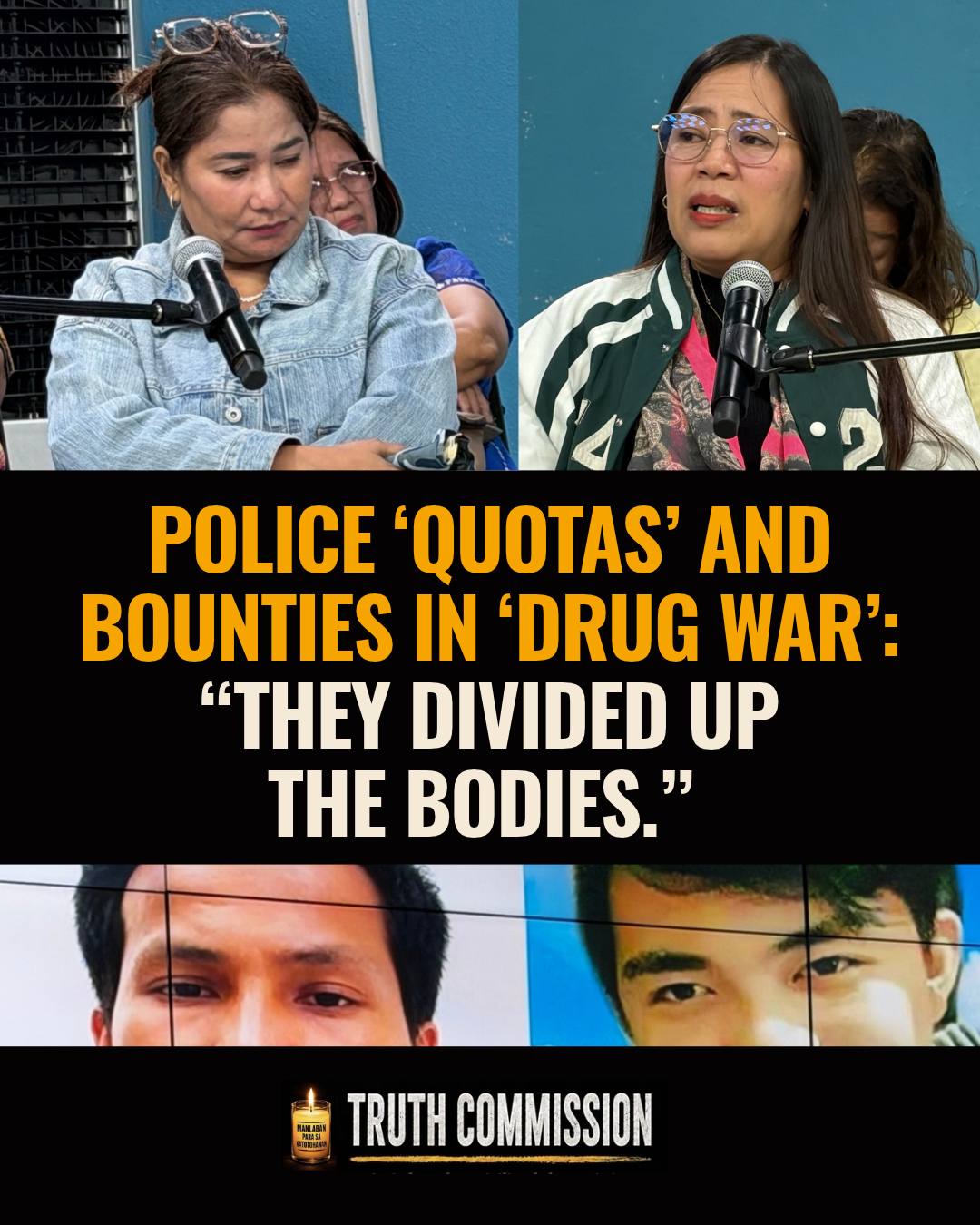
Marissa Lazaro, a mother of a victim, told the commission she suspects police split the killing of four friends between two towns to fill their quotas.
“Perhaps in Bocaue, one police unit needed to meet its quota, and here in Marilao they already had two,” she said in Filipino during the 6th Public Truth-Telling Session of the commission last Friday, Nov. 6. “So they just divided up the bodies, even though they were killed together.”
She offered it as a suspicion, not as evidence. Her son, Christopher Lazaro, 20, and Alberto Paragas, 32, were found dead in Marilao, in Bulacan Province, on Aug. 5, 2017. The other two men were found hours apart from them in nearby Bocaue, she said. Police said the men died after an alleged attempted holdup. The idea came to her years later, she said, at rallies where she heard that every head carried a price.
Nothing presented at the hearing showed that a quota or reward played a part in these deaths, which is why the commission calls for an investigation. But Dr. Raquel Fortun, the forensic pathologist and commission member, said the death certificates for both men were deficient and the scene photographs poor, calling the case “clearly not a basic homicide investigation.” She also questioned whether the doctor who documented ligature marks on Christopher’s wrists had been free to challenge police.
The suspicion echoes accounts that have surfaced since the first months of the “drug war.”
In a 2017 report, Amnesty International quoted a Manila anti-drug officer who said police were paid 8,000 to 15,000 pesos for each person killed. That April, Reuters reported that a senior officer said police were handed quotas of “surrenderers.”
In 2024, officers testified before a House panel. Lt. Col. Jovie Espenido said in August that leaders had imposed a daily quota of 50 to 100, which he understood to mean visiting that many suspected households. In October, Royina Garma, a retired police colonel, said rewards for “drug war” killings ranged from 20,000 pesos to 1 million pesos.
In November 2024, Rodrigo Duterte, the former president, confirmed to the same House panel that a cash reward system existed, though he said it did not pay police to kill. His office had denied in 2017 that police received rewards for killing drug suspects.
The most formal findings came in April. Judges at the International Criminal Court confirmed crimes against humanity charges against Duterte, finding substantial grounds to believe that police who killed a person on a list tied to him could claim secret rewards of 50,000 pesos to 1 million pesos. Duterte denies the charges, saying he told police to kill only in self-defense. He is presumed innocent, and the case will be tried in The Hague starting Nov. 30.
The commission raised a related question last month. In an Oct. 14 press release, it said its review of public records showed that some police commanders linked to “drug war” killings were later promoted or moved to more powerful posts. One, Chito Bersaluna, was removed as Caloocan police chief after officers killed Kian delos Santos, 17, in August 2017. He became a brigadier general in March 2022. Police leaders defended his appointments, and he was not charged in the killing. Dr. Chris Magno, the commission’s executive director, said the appointments alone did not prove that killings led to promotions, but that the career histories warranted an independent inquiry.
Marissa said the funeral home that handled her son’s body, which she was told was accredited by police, charged 40,000 pesos but issued a receipt for 35,000, calling the difference “for the boys.” She offered no proof of a payment to officers.
Asked what she would say to officers today, Marissa said she would ask whether they could bear it if what was done to her family were done to their own children. *(Truth Commission) *