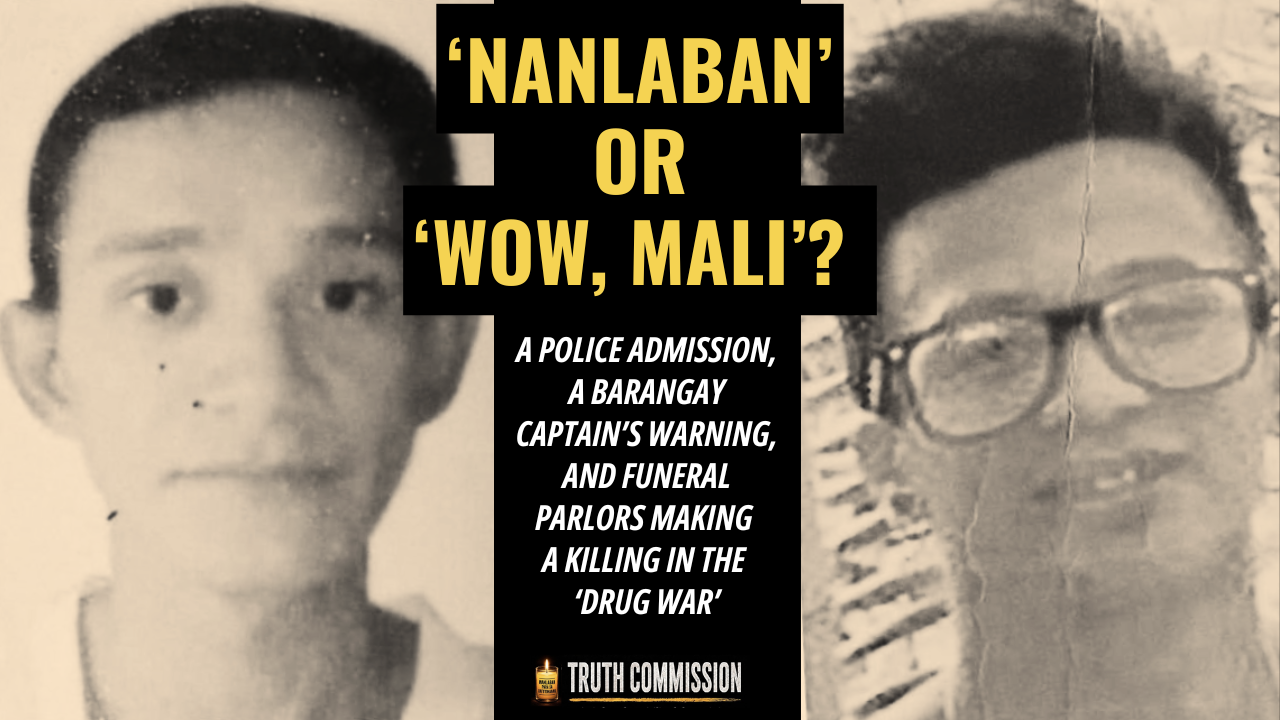
CALOOCAN CITY (Nov. 13, 2026) — Neighbors heard the police talking quietly to each other after the shooting. “Pare, na-wow mali tayo,” one officer allegedly told another (“Buddy, we got it wrong”). The officers were standing over the body of Romeo Tuparan Jr., known as Toto. He was a 33-year-old house painter on the Caloocan City Hall payroll. Police shot him dead outside his home on July 10, 2017.
His mother, Retchie Depamaylo, told the Truth Commission that her godchild heard the exchange and that other neighbors repeated it. She said the house walls in her neighborhood are thin, made of wood full of gaps, so people inside could hear and see what happened on the street. The police report said Tuparan fought back.
Death did not end the families’ troubles. Both mothers said that after their sons were killed, private funeral parlors took the bodies before the families had a say. The parlors then held the bodies until the families paid. One mother was charged 35,000 pesos. The other was charged 80,000 pesos. Cardinal Pablo Virgilio David told the commission that at the time, the Diocese of Kalookan’s charity funeral service charged only 7,000 pesos for everything. He said the diocese could not get bodies because brokers were paid commissions to send them to private parlors.
Depamaylo and Marina Abuda, whose son Kiermile Ledesma was killed in November 2016, testified on October 27 at the St. Therese Mission Headquarters of the Diocese of Kalookan. It was the commission’s seventh truth-telling session and the first with more than one witness. The session was recorded but not livestreamed. It can be viewed here: https://www.youtube.com/watch?v=UhdFWo6wTrE
Their accounts add to the commission’s record of the killings under former President Rodrigo Duterte’s “drug war.” Judge Raul Pangalangan, the commission’s chair, said the government still has no full record of those deaths.
A Neighborhood Sealed Off
Depamaylo said trouble began around 2 p.m. that Monday. About 20 armed police officers started circling her neighborhood.
Her son came home from work around 5 p.m. and took a bath. She told him to stay indoors. He refused. “Why shouldn’t I go out, Ma? I haven’t done anything wrong, and I don’t sell shabu,” she recalled him saying. She gave him 10 pesos for cigarettes and followed him to the corner, where she stood by a post to keep watch. Then people started running. Mother and son ran down different alleys, and she heard a single shot. She learned later that police had shot him in the leg.
Police then cleared the area. “Close your doors, turn off your lights,” she quoted the officers as saying, as they ordered stores shut and kept residents inside.
‘Please Don’t Kill Me’
A neighbor saw what happened next. She was a moneylender who had been passing through, collecting payments. According to Depamaylo, the wounded Tuparan grabbed the woman’s knee. “Don’t leave me. Please call my mama,” he said. Neighbors watching through their windows heard him beg, “Please, please don’t kill me.”
His hand was pulled off the woman. “When my kumare turned her back, then pak, pak, pak,” Depamaylo said. She said the neighbor saw three shots, to the head and the chest.
The witness has refused to testify. Depamaylo said the woman is still afraid of what she saw.
When Depamaylo reached the yellow tape, police would not let her see her son. They showed her only a photo on a cellphone. Her sibling and neighbors pulled her away, afraid the police would kill her next.
‘My Son Was on His Knees’
The police said Tuparan fought back. They claimed he had a gun and shabu in his pocket.
“Fought back? There were so many of them, and my son was on his knees. How could he fight back?” Depamaylo said. The police returned his belongings: a 40-peso bill, still bloody.
She said that when investigators asked about his job, she told them he painted walls for City Hall. “Even if my son used shabu, I would have been willing for you to jail him,” she said. “Why did you have to kill him?” No case was ever filed, and she knows of no investigation.
**A Forensic Doctor Questions the Police Versionv
Dr. Raquel Fortun, a forensic pathologist and member of the commission, examined Tuparan’s remains after they were exhumed in 2022 from the Manila North Cemetery. She said his case was unusual because she had detailed photos of him at the scene, with close-ups of the wounds. She found that he had been shot several times, mostly in the chest.
One police report stood out to her. A child was also hit by gunfire that day, and the police investigator concluded that Tuparan fired the shot.
“Wow, convenient,” Dr. Fortun said. She said the police reached that conclusion without any independent scientific investigation. She later said she found it “highly questionable” that police so quickly blamed the dead man.
De Pamilo said her son had no gun, at home or on him. The commission does not know whether the child survived. People in the neighborhood said the child was taken to the hospital.
The Captain’s Warning
Kiermile Ledesma, 24, was the second of Abuda’s four children. He loaded sacks of rice for extra cash and was known in Caloocan’s basketball leagues as a frequent MVP.
On Nov. 24, 2016, a day before he was killed, the barangay captain came to Abuda with a warning. “Marina, have your son lay low, because someone is looking for him,” she quoted the captain as saying. He told her the people looking for her son were police. Abuda said she now believes the captain knew more than he told her.
That night her son came home with red eyes and left without explaining. Hours later, he went home and asked what she wanted for dinner. He cooked her sinigang. She told him she had a bad feeling. “Ma, whatever you’re thinking, just sleep it off,” he said.
Shot in the Head, Then Run Over
Around 12:45 a.m. on Nov. 25, gunfire broke out near a bakery four houses away. Abuda was asleep.
Her eldest daughter ran out and found her brother’s body. The wounds were all to the head. A neighbor across the street told the family the gunmen were two pairs of men on two motorcycles, all wearing bonnets. “And what hurts most is they ran him over,” Abuda said.
Abuda said a child nearby heard Ledesma’s last words. “Tell my sister and my mommy goodbye. Forgive me,” she said he told the child. Dr. Fortun said she doubts he could have spoken after wounds that serious.
Dr. Fortun did not examine Ledesma’s body herself, but she reviewed the police medical report on his death. It lists nine gunshot wounds, each passing through the skull, and no wounds anywhere else on his body. Abuda had heard there were 16.
“This is so awful,” Dr. Fortun said. “Imagine, they went for the head.”
She said any marks from the motorcycle tires were lost long ago. They could have been documented if the first doctor had looked for them or if his clothes had been kept.
Three Friends Dead in One Day
Abuda said her son was one of three friends killed the same day in different Caloocan barangays. She believes police were behind it, partly because of talk in the neighborhood about “kota” or police killing quotas. Cardinal David said the killings fit a pattern from that time. Hooded men on motorcycles worked from lists of targets instead of carrying out open police operations. He asked the commission’s staff to find the families of the two other young men. Ledesma’s killing was listed as the work of “unknown” gunmen.
Abuda also said two women she called “asset” had kept close to her son and tracked where he was.
Bodies Held Until Families Paid
Both mothers described funeral parlors that arrived fast, took the bodies and then would not let them go. Abuda said crime scene investigators were still interviewing her when the parlor showed up, about 20 minutes later. Nobody had called it.
“You’re really something. Twenty minutes and they’re already here,” she said she told the investigator. “Your commission must be big.” She suspects the investigators split a fee with the parlor.
The parlor then had her sign a paper while she was still in shock. “They took advantage of me because I was dazed. I didn’t read what I signed,” she said. Because of that signature, she could not move her son to a cheaper parlor, and she was charged 80,000 pesos.
Depamaylo’s experience was similar. The parlor that took her son would not release him to the one she chose. “They wouldn’t give him back, because I had no money to pay,” she said. A church in Baclaran eventually paid for the funeral.
To pay her debts, Abuda went to the Department of Social Welfare and Development and the Philippine Charity Sweepstakes Office. She also ran sakla, a card game, at the wake for more than a week to raise money. Candles cost 700 pesos a day, and opening the family tomb cost 32,000 pesos. Her estranged husband pocketed some of the donated money and held on to the death certificate.
Cardinal David said brokers earned commissions for steering bodies to private parlors. “Because we don’t give commissions, we can’t get any bodies,” he said. Parlors also told families that the diocese’s service could not take bodies because it was not accredited to do autopsies. Some charged families for autopsies the government should have done for free.
Dr. Fortun raised another concern. A funeral parlor in Quezon City had been abandoned with bodies still inside, and city officials had to step in. She believes some were victims of the “drug war” killed when the killings were at their height. Cardinal David said the Night Crawlers, a group of photographers who covered the killings, documented bodies piled in a morgue.
Father Flavie Villanueva asked the commission to make funeral parlors a special focus of its work. The commission also said it would request official homicide figures for the period.
A Mother Who Sought Help
Abuda spoke openly about her son’s struggles. She said he changed after his father left the family. Neighbors told her he was involved with shabu. She found a gun in his drawer, and he told her it was “for protection.” Household items started to disappear.
She looked for a rehab center, but the one she found in Pampanga wanted 7,000 pesos up front, which she did not have.
Cardinal David said the diocese’s free community-based rehab program started only in 2017, after Ledesma was dead.
“Even if you jail him again and again, I can still visit him,” Abuda said she told the police.
Living With the Loss
Tuparan was Depamaylo’s only child. She is now raising his son, who is about to turn 17, with help from the diocese and Program Paghilom, Father Villanueva’s support group for “drug war” families.
Abuda said she still cannot accept her son’s death. “In my mind, my son is just working abroad. I don’t think of him as dead,” she said. She said he once told her, “Ma, I want you to be brave even when I’m gone.”
Fear kept people away from the wakes. “People were afraid to keep vigil. They thought they would be shot too,” Depamaylo said.
Asked what justice means to her, Depamaylo said, “Whoever planned my son’s killing must pay.” She said that includes those responsible for all the killings under Duterte.
Abuda said she has forgiven Duterte because she does not want hatred to guide her. But she wants the people at the top held to account. She said she would support any trial.
“Killing is not the solution,” Abuda said.
The session ended with a vacant-chair ritual for both men, as Undas approaches and the 10th anniversary of Ledesma’s death nears. (Truth Commission)