FOR IMMEDIATE RELEASE
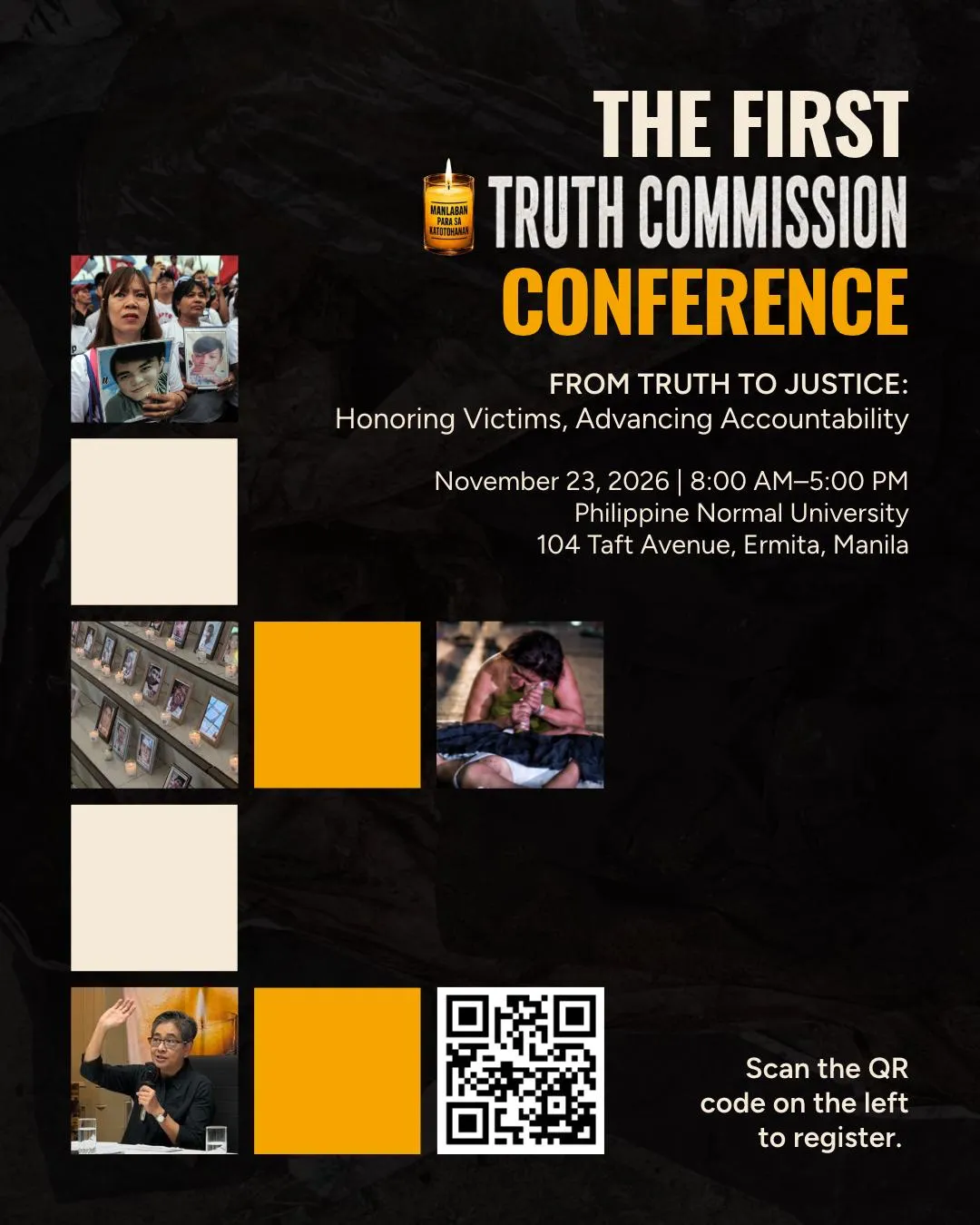
MANILA, Nov. 16, 2026 — The Truth Commission, the independent civilian body examining the killings of former President Rodrigo Duterte’s so-called “war on drugs,” will make public its first findings on Monday, Nov. 23, at its inaugural conference at Philippine Normal University in Manila.
The centerpiece of the daylong gathering, titled “From Truth to Justice: Honoring Victims, Advancing Accountability,” is the Chair’s Report. Judge Raul C. Pangalangan, the commission’s chair and a former judge of the International Criminal Court, will deliver it at 9:20 a.m. The report sums up what the commission has established since its launch in May about the people who were killed and the places where the killings clustered.
More than a decade after the killings started in 2016, the Philippines still has no single, agreed count of the dead. Official tallies and the estimates of human rights groups differ by thousands. Building a reliable record of who died, and how, has been among the commission’s central aims from the start.
Working Dataset of 8,320 Cases
In its first six months, the commission assembled a working dataset of 8,320 documented killings from 2016 to 2022, with incidents recorded in 72 provinces and 730 cities and municipalities. The records draw on databases shared with the commission by church and survivor-support groups, among them Program Paghilom of the Arnold Janssen Kalinga Foundation, Caritas Kalookan Inc., the Solidarity of Orphans and Widows and the San Jose ang Tagapagtanggol Parish.
The commission also drew on police and other government records, along with news reports, social media posts and online memorials. Post-mortem examinations by the commission’s forensic and investigation unit, headed by Dr. Raquel Fortun, added dozens more cases.
The commission’s review of its sources found that a single killing may be recorded by several independent sources. That allows accounts to be compared and checked against one another while each source remains traceable. All of these records are in the commission’s National Registry, which is already published online and continues to be updated as the commission reviews and links records.
“These six-month findings show why the truth must be built one person and one incident at a time,” Judge Pangalangan said. He said the National Registry brings together records from families, communities, journalists, researchers and public agencies, making it possible to compare accounts and examine what happened. “This work is laying the groundwork for accountability, remedies for families, and reforms that help prevent these killings from happening again,” he added.
The Chair’s Report will be followed at 10 a.m. by a response from Fredderick A. Vida, the secretary of justice. At 10:30 a.m., Dr. Christopher N. Magno, the commission’s executive director, will present “Mapping the Human Cost,” a closer look at the commission’s data on who the victims were and where they lived and died.
What the Bodies and the Paperwork Show
Two afternoon reports will build on those findings by examining the evidence left behind by the killings.
At 1 p.m., Dr. Fortun, a forensic pathologist and member of the commission, will present “Posthumous Dignity,” the forensic division’s examination of drug war deaths. Officials from government agencies, including the Department of Health and the Commission on Human Rights, have been invited to respond.
At 1:40 p.m., Dr. Bono Olgado of the commission’s documentation and archives division will present “Documenting the Truth: Gaps and Inconsistencies in Government Records of Drug War Killings.” Drawing on data the commission has gathered, the report examines death certificates that misstate how people died and police reports, including crime-scene reports, that leave out key details. It also flags birth dates that do not match from one government document to the next. Dr. Olgado will discuss what these flaws mean for families seeking the truth and for any future effort to hold those responsible to account.
Two more division reports will follow. Ansheline Bacudio, a lawyer and program director at IDEALS Inc., will draw policy lessons from the commission’s truth-telling sessions with families. Dr. Al Fuertes, a commissioner, will speak on trauma and healing among families of victims, including what justice means to them.
Voices of Families and Witnesses
The conference also gives families and witnesses a central place. In a morning session led by Cardinal Pablo Virgilio S. David, the commission’s adviser and convenor, five people who have given testimony to the commission will share their accounts and take questions. Young people from Program Paghilom, a support program for families of victims, will stage a theater performance based on the stories of affected families. Mothers of victims will take part in a poetry workshop.
In the afternoon, Cardinal David will speak on the church’s role in offering sanctuary and help to survivors and to journalists. Concurrent panels will bring together journalists who covered the killings, scholars, community workers and lawyers. One panel will look at efforts to help victims take part in the International Criminal Court’s investigation, with lessons drawn from South Korea’s truth commission.
The day will close with the presentation of plaques to six people who gave testimony, followed by closing remarks from Judge Pangalangan.
Event Details
The conference runs on Monday, Nov. 23, at Philippine Normal University, 104 Taft Avenue corner Ayala Boulevard, Ermita, Manila. Registration opens at 8 a.m., and the program runs from 8:30 a.m. to 5:30 p.m. Members of the media are invited to cover the conference, and those planning to attend should email the commission at media@truthcommission.ph.
The Truth Commission is a civilian-led body launched on May 27, 2026, by members of the Catholic Church and civil society, and it operates independently of the government. It documents the killings and related abuses of the Philippine government’s drug war and hears the testimony of victims’ families and witnesses. Its aim is a public record that can support both accountability and healing. (Truth Commission)